
Introduction
One of the most common questions organizations ask when considering a security assessment is: how much does penetration testing cost? It is a fair question, and one that deserves a straightforward answer. Unfortunately, the penetration testing market in Canada can feel opaque, with pricing that varies significantly depending on the provider, the scope of the engagement, and the type of testing required.
Understanding penetration testing costs is critical for effective budgeting and for evaluating proposals from potential testing partners. Overpaying for a basic engagement wastes resources, while choosing the cheapest option often results in superficial testing that fails to uncover real vulnerabilities. The goal is to find the right balance between cost and thoroughness.
This guide breaks down typical penetration testing costs in Canada for 2026, explains the factors that influence pricing, and provides practical advice for budgeting your security assessments. Whether you are planning your first penetration test or looking to optimize an existing testing program, this guide will help you make informed decisions about your investment.
What Does Penetration Testing Cost in Canada?
The average cost of a penetration test in Canada varies significantly based on the type of assessment, the scope of the engagement, and the complexity of the target environment. As a general benchmark, most professional penetration testing engagements fall somewhere between a few thousand dollars for tightly scoped assessments and well into six figures for large-scale red team exercises.
The wide range exists because penetration testing is not a one-size-fits-all service. A focused phishing engagement targeting a specific department requires a fundamentally different level of effort than a comprehensive internal network penetration test covering thousands of hosts across multiple subnets, or a red team engagement simulating an advanced persistent threat over several weeks.
Rather than focusing on specific dollar figures, which can be misleading without context, it is more useful to understand the factors that drive penetration testing costs. Two engagements with the same service label can differ dramatically in price depending on the scope, complexity, and methodology involved. The sections below break down these factors so you can evaluate proposals with a clear understanding of what you are paying for.
Organizations should be cautious of pricing that seems unusually low for the stated scope. Below-market pricing often indicates heavy reliance on automated scanning tools rather than genuine manual testing. A penetration test priced at a fraction of what other providers are quoting is likely a repackaged vulnerability scan, which provides far less value and may not satisfy compliance requirements.
Factors That Affect Penetration Testing Pricing
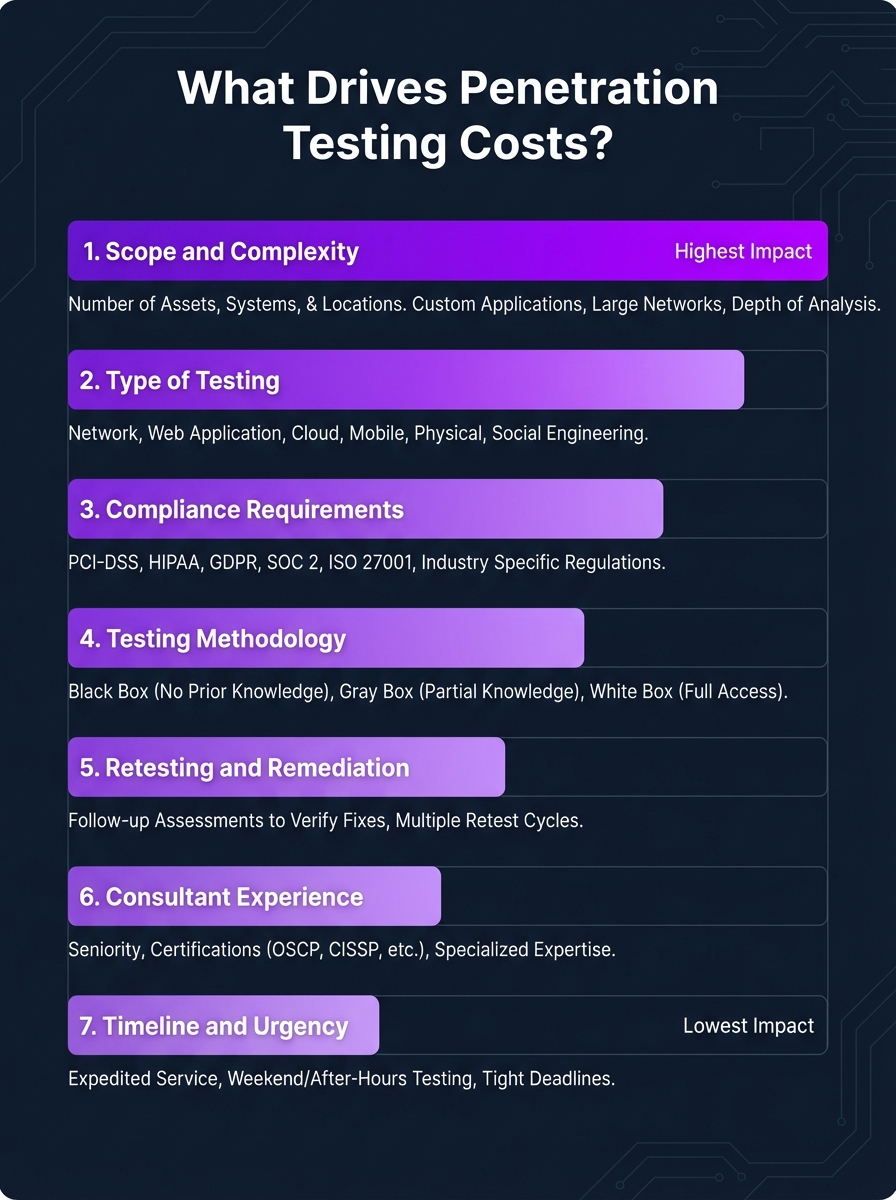
Understanding the factors that drive penetration testing costs helps you evaluate proposals accurately and ensure you are comparing equivalent services. The following factors have the most significant impact on pricing.
Scope and Complexity
The scope of the engagement is the single largest determinant of cost. A penetration test targeting a single web application with limited functionality will cost a fraction of an assessment covering an enterprise network with thousands of hosts, multiple applications, and interconnected cloud environments.
Key scope elements that affect pricing include:
- Number of IP addresses or hosts in scope for network testing
- Number of applications and their complexity for web and mobile assessments
- Number of user roles and access levels requiring testing
- Number of API endpoints for API-focused engagements
- Size and complexity of the cloud environment for cloud penetration testing
Type of Testing
The approach to testing directly impacts the level of effort and, consequently, the cost:
- Black box testing simulates an external attacker with no prior knowledge of the target. Testers must spend time on reconnaissance and discovery, which can increase the engagement duration.
- Grey box testing provides testers with partial knowledge, such as user credentials or network diagrams. This approach is the most common and offers an efficient balance between realism and coverage.
- White box testing gives testers full access to source code, architecture documentation, and credentials. While this enables the deepest analysis, the volume of information to review can increase the overall effort.
Compliance Requirements
If your penetration test is being conducted to satisfy a specific compliance framework, the engagement may require additional reporting and documentation. Testing performed for PCI DSS compliance, for example, must follow specific scoping requirements and produce reports that map findings to PCI DSS controls. Similarly, SOC 2 assessments may require specific testing criteria and reporting formats. This additional overhead is typically reflected in the cost.
Testing Methodology
Not all penetration tests are created equal. The methodology employed by the testing provider has a significant impact on both cost and value:
- Manual-first testing relies on skilled consultants to perform the majority of testing by hand, supplemented by specialized tools. This approach uncovers complex vulnerabilities such as business logic flaws, chained attack paths, and authorization bypasses that automated tools cannot detect. It is more expensive but delivers substantially more value.
- Automated-heavy testing relies primarily on commercial scanning tools with limited manual validation. This approach is cheaper but produces results that are little better than a standalone vulnerability scan.
When evaluating proposals, ask providers what percentage of their testing is performed manually. This is one of the most important indicators of test quality.
Retesting and Remediation Validation
After your team remediates the vulnerabilities identified during a penetration test, you need validation that the fixes were implemented correctly. Some providers include remediation retesting as part of the original engagement, while others charge separately for this service. Retesting fees, when charged separately, can add thousands of dollars to the total cost.
Consultant Experience and Certifications
The expertise of the consultants performing your penetration test directly affects the quality of the results. Senior consultants holding advanced certifications such as OSCP, OSCE, and OSWE command higher rates than junior testers, but they are also far more likely to uncover critical vulnerabilities that less experienced testers would miss. The cost difference between an experienced team and a junior team often pays for itself through the depth and quality of findings.
Timeline and Urgency
Standard penetration testing engagements are typically scheduled two to four weeks in advance. If you require testing on a compressed timeline, most providers charge a premium for rush or emergency engagements. Planning ahead and booking your tests in advance helps avoid these additional costs.
What’s Included in a Penetration Test?
When evaluating penetration testing proposals, it is important to understand what deliverables and activities should be included in the engagement price. A comprehensive penetration test should include the following components:
-
Pre-engagement scoping and planning: A thorough discovery process where the testing team works with you to define the scope, objectives, rules of engagement, and testing timeline. This phase ensures that the engagement is aligned with your security goals and compliance requirements.
-
Active testing period: The core testing phase where consultants actively test your systems for vulnerabilities. This includes reconnaissance, vulnerability identification, exploitation, post-exploitation, and lateral movement testing as applicable to the engagement type.
-
Detailed findings report with evidence: A comprehensive technical report documenting each finding with proof-of-concept evidence, screenshots, and reproduction steps. Each finding should include a clear severity rating and detailed description of the business impact.
-
Executive summary for leadership: A high-level summary designed for non-technical stakeholders that communicates the overall risk posture, key findings, and strategic recommendations. This enables your leadership team to understand the results without wading through technical details.
-
Remediation guidance: Actionable, prioritized remediation recommendations for each finding. These should be specific enough for your development or infrastructure team to implement fixes without ambiguity.
-
Debrief presentation: A live walkthrough of the findings with your technical and management teams. This session allows you to ask questions, clarify findings, and discuss remediation strategies directly with the consultants who performed the testing.
-
Remediation retesting: Validation that your remediation efforts have successfully addressed the identified vulnerabilities. DarkPoint Security includes complimentary remediation retesting with every engagement, ensuring that your fixes are verified without additional cost.
If a provider’s proposal does not include one or more of these components, ask whether they are available and what the additional cost would be. Missing deliverables can significantly reduce the value of the engagement.
Hidden Costs to Watch For
While most reputable penetration testing providers offer transparent pricing, there are several common areas where unexpected costs can arise. Being aware of these potential charges helps you compare proposals accurately and avoid budget surprises.
Retesting Fees
As mentioned above, some providers charge separately for remediation retesting. These fees can add significantly to the total engagement cost depending on the scope of the retest. Always clarify upfront whether retesting is included in the quoted price or billed as a separate engagement.
Report Customization
Standard penetration test reports follow a consistent format. However, if you require custom report formatting, additional executive summaries for different audiences, or supplementary documentation, some providers charge extra for these customizations.
Compliance-Specific Reporting
If your penetration test must satisfy specific compliance requirements such as PCI DSS or SOC 2, the additional reporting overhead may be priced separately from the base testing fee. Ensure that compliance-specific deliverables are explicitly included in the proposal if they are required.
Emergency and Rush Pricing
Penetration tests requested on short notice or with compressed timelines typically incur a premium. Rush fees can add substantially to the standard engagement price. Planning your testing schedule in advance is the simplest way to avoid these charges.
Travel Costs for On-Site Testing
Certain types of testing, such as internal network penetration testing, wireless assessments, and physical penetration testing, may require consultants to be on-site at your facilities. For providers located outside your region, travel expenses including flights, accommodation, and per diem costs can add significantly to the total engagement price. Working with a Canadian-based provider can help minimize these costs.
How to Budget for Penetration Testing
Building penetration testing into your annual cybersecurity budget ensures that your organization maintains a consistent security testing program without scrambling for funds when an assessment is needed. Here are practical strategies for budgeting effectively.
Establish an Annual Testing Budget
Most organizations should budget for at least one comprehensive penetration test per year. For environments that handle sensitive data or are subject to regulatory requirements, quarterly or semi-annual testing is more appropriate. When setting your annual budget, account for the types of testing you need, the scope of your environment, and any compliance-driven testing requirements.
The appropriate annual budget depends heavily on the size of your environment, the number of applications and systems in scope, and any compliance-driven testing requirements. As a starting point, consider the types of assessments you need each year and request scoping quotes from potential providers. This gives you a realistic baseline tailored to your specific environment rather than relying on generic industry averages.
Test After Major Changes
Beyond scheduled annual testing, penetration tests should be conducted after any significant changes to your environment. This includes:
- Major application releases or significant feature updates
- Infrastructure migrations to new platforms or cloud environments
- Mergers and acquisitions that introduce new systems and networks
- Architecture changes such as network redesigns or new integrations
Building a contingency budget for unplanned testing ensures you can respond to these changes without delaying your security validation.
Follow Compliance-Driven Testing Calendars
If your organization must comply with standards that mandate penetration testing, your testing schedule should align with the compliance calendar. For example, PCI DSS requires penetration testing at least annually and after any significant infrastructure or application changes. SOC 2 engagements typically require annual testing aligned with your audit period. Building your testing schedule around these requirements ensures that reports are available when auditors need them.
Build a Long-Term Testing Program
Rather than treating penetration testing as a one-off expense, develop a multi-year testing program that rotates through different areas of your environment. For example:
- Year 1, Q1: External network and web application testing
- Year 1, Q3: Internal network and cloud environment testing
- Year 2, Q1: Web application and API testing
- Year 2, Q3: Red team engagement and phishing assessment
This rotational approach ensures comprehensive coverage over time while spreading costs across multiple budget cycles. Establishing a long-term relationship with a trusted testing partner can also lead to more efficient engagements, as the provider develops familiarity with your environment and can focus on changes since the last assessment.
Penetration Testing vs Vulnerability Scanning: Cost Comparison
Organizations sometimes consider vulnerability scanning as a lower-cost alternative to penetration testing. While vulnerability scanning is indeed less expensive per engagement, it serves a fundamentally different purpose and should not be treated as a substitute.
| Factor | Vulnerability Scanning | Penetration Testing |
|---|---|---|
| Cost | Lower per engagement | Higher, reflecting manual expert effort |
| Approach | Automated tools | Manual, expert-driven |
| Depth | Surface-level, known vulnerabilities | Deep analysis with active exploitation |
| Business Logic Testing | Not possible | Thorough coverage |
| False Positive Rate | High | Low (findings are manually verified) |
| Compliance Value | Meets scanning requirements only | Satisfies penetration testing mandates |
Vulnerability scanning provides valuable breadth of coverage and should be part of every organization’s security program. However, it cannot replace the depth, context, and real-world attack simulation that penetration testing delivers. The cost difference reflects the significant expertise, time, and manual effort involved in a genuine penetration test.
For a detailed comparison of these two approaches, read our guide on Penetration Testing vs Vulnerability Scanning.
How to Choose a Penetration Testing Provider
While cost is an important consideration, it should not be the sole factor driving your choice of penetration testing provider. The cheapest option rarely delivers the best results, and the consequences of a subpar penetration test, namely a false sense of security, can be far more costly than the test itself.
Certifications to Look For
The certifications held by the consultants who will perform your test are a strong indicator of their technical capabilities. Look for providers whose team members hold advanced offensive security certifications such as:
- OSCP (Offensive Security Certified Professional): The industry-standard certification for penetration testers, requiring hands-on practical examination.
- OSCE (Offensive Security Certified Expert): An advanced certification focused on exploit development and creative attack techniques.
- OSWE (Offensive Security Web Expert): A specialized certification for web application security testing and source code analysis.
These certifications require practical, hands-on demonstrations of skill rather than multiple-choice exams, making them reliable indicators of real-world competence.
Manual vs Automated Testing Approach
Ask prospective providers what percentage of their testing is performed manually versus through automated tools. Providers that rely heavily on automated scanners will produce results that are little better than a vulnerability scan. Look for providers that emphasize a manual-first methodology, using automation to supplement and accelerate human-driven testing rather than replace it.
Sample Report Quality
Request a sample report from any provider you are evaluating. The report is the primary deliverable of a penetration test, and its quality directly determines the value you receive. A strong report should include clear evidence of exploitation, well-articulated business impact assessments, and specific, actionable remediation recommendations. Beware of reports that consist primarily of automated scanner output with minimal analysis.
Compliance Experience
If your penetration test is being conducted to satisfy a compliance requirement, choose a provider with demonstrated experience in the relevant framework. Providers experienced with PCI DSS, SOC 2, and other frameworks understand the specific testing criteria, scoping requirements, and reporting formats needed to satisfy auditors.
Data Residency and Canadian Regulations
For Canadian organizations, data residency is an increasingly important consideration. During a penetration test, consultants may access or handle sensitive data, including customer information, financial records, and proprietary business data. Working with a Canadian-based provider ensures that your data remains within Canadian jurisdiction and that the provider is familiar with Canadian privacy regulations, including PIPEDA and provincial privacy legislation. This is particularly important for organizations in regulated industries such as healthcare, finance, and government.
For a comprehensive guide on evaluating penetration testing providers, read our article on Choosing a Penetration Testing Company.
Conclusion
Penetration testing is a critical investment in your organization’s cybersecurity posture, and understanding the factors that drive cost is essential for making informed decisions. The price of a penetration test in Canada varies widely based on scope, complexity, methodology, and compliance requirements, and the right engagement for your organization depends on your specific environment and objectives.
The key to maximizing the value of your penetration testing budget is to focus on quality over cost. A thorough, manual-first penetration test performed by experienced professionals will uncover vulnerabilities that cheaper, automated-heavy alternatives will miss. The cost of a quality penetration test is a fraction of the potential financial and reputational impact of a security breach.
When evaluating proposals, look beyond the bottom-line price. Consider the methodology, the certifications of the consultants, the comprehensiveness of the deliverables, and whether retesting is included. These factors collectively determine the true value of the engagement.
DarkPoint Security delivers comprehensive, manual-first penetration testing services across web application, external network, internal network, cloud, and red team engagements. Every engagement includes detailed reporting, executive summaries, remediation guidance, debrief presentations, and complimentary remediation retesting. For organizations in the GTA, learn more about our penetration testing services in Toronto.
Ready to discuss your penetration testing requirements? Contact us to receive a tailored quote based on your specific environment and objectives.